 |
| The project (2012) is a collaboration with Eleanor Dare - presented in ISEA 2013 Sydney
The
digital Dreamhacker is an application that collects dream themes reported by
individual dreamers and turns them into crowdsourced imagery. These dream
visualisations are then uploaded onto the Social Web allowing for
further commentary and collective interpretation. This way, we focus on the social
context of dreams, creating visualisations that are neither a depiction of
individual imaginings or a means of enhancing artistic skill, but a reframing of dreams
within the technical and social imaginary, which forms our collective
understandings and expectations of social life. We outline a research strategy
in which social media, supported by methods that emanate from both critical
design and network analysis, are innovative contexts for exploring the
connection between technology, culture and our individual ‘imaginings’,
including our dreams.
read our paper http://ses.library.usyd.edu.au/handle/2123/9749 |

Saturday, 26 October 2013
The Digital Dreamhacker: Crowdscoursing the dream imaginary

Friday, 25 October 2013
Design, story-making and play through child- adult partnerships(PhD research)
In the name of civic collaboration, my research and practice disrupts hierarchies between adult, child, teacher learner


 |
| Workshops between December 2007 and March 2011 |
Abstract
This thesis explores how designing and story-making
capabilities can be combined and used as everyday inventiveness for all. It
examines the learning that arises out of “getting lost” in child-play and
fictional speculation when combined with an iterative design process. The
research highlights the value of this combination for individual
self-discovery, criticality, fostering social engagement and responsibility.
This thesis reviews existing cases where designing and
playfulness have been combined and highlights the lack of examples where design
is recognised as a valuable everyday process for everyone. At the same time, it
explores the consequences of losing the childhood expertise with the onset of
adulthood.
In this context, this thesis examines a partnership between
adult designers and children working together on an imaginary design brief. The
aim is to explore the possibility for children to acquire capabilities and
experience how they might stream their playfulness into their adult roles as
everyday designers, researchers and story-makers. At the same time, this thesis
explores if and how the adult designers can temporarily plunge back to a
childhood state and learn from the children.
The research involved undertaking and analysing a series of
explorations with children or adult participants that led to the final
adult-child partnerships. While, the “learning in action” nature of these
engagements bears similarities with “Action Research”, this thesis trials a new
approach introducing story-making as a research method.
The thesis findings propose a new method that allows adults to look at
the world through the lenses of child expertise and for children to value their
own expertise and experience its applications in adulthood. The thesis is
primarily directed at designers and the design education research community,
although its findings are relevant for educators, parents and everyone that is
interested in creativity in life.
parts of this research have been presented and published in
2013 / Media Arts Festival, Honf Fab Lab, Indonesia
2011 / 7th Creative Engagements Speaking with Children - Mansfield College Oxford
2011 / PATT 25 & CRIPT 8: Perspectives on Learning in Design & Technology Education
2011 / Between Narrative and Embodiment, Czech Memorial Scrolls Museum, London
2010 / After fiction - Copenhagen University
2010 / Modelling, Designing, Society. Ken Banes Seminar Series - Goldsmiths, TERU
2010 / Aesthetics and History - Stockholm University
2010 / Inter-Art. Metaphors in Aesthetic Theory - Freu University Berlin
2009 / 5th Creative Engagements, Thinking with Children - Mansfield College Oxford
2009 / Forms of Engagement, Concepts of Politics - Copenhagen University
2009 / Desperately Seeking Authenticity - Goldsmiths, London
2008 / Once Upon a tine to Ever After - Thursday club, Goldsmiths, London
find some of my papers here
Cultural probes - Interaction research studio - Goldsmiths
The storybook probe  
In 2009, I worked as a researcher at the 'Interaction Research Studio' at Goldsmiths - Department of Design, where we collaboratively created the storybook probe called 'Around my home in 80 days': a book that invites its readers- participants to create narratives and designs about their homes with a view to inspire designers-researchers who work with domestic interaction design.
 |
| probes
Later, I was involved in the creation other cultural research probes:
'a design-led approach to understanding users that stressed empathy and
engagement'. These included 'collections of evocative tasks meant to elicit inspirational
responses from people—not comprehensive information about them, but fragmentary
clues about their lives and thoughts'.
|

The Phi books project


Since 2008 I have initiated and run a very well-received research
project in collaboration with Eleanor Dare (Goldsmiths-Computing department)
called the 'the Phi books': a project
that uses the house as a metaphor for collaboration; the notion of
collaboration, consent and shared authorship is being explored while creating
participatory narratives, algorithms and designs about the participant's mental
or physical houses. This has resulted in digital applications, book productions,
conference presentations and theatrical performances in Copenhagen University, Berlin University, Goldsmiths University of London,
Istanbul Sabanci University, and Stockholm University; also exhibitions at the Victoria and Albert museum London,
publications with Leonardo Journal and a book chapter in an edition called 'Writing between
disciplines'.
see more here
The family cook book Newcastle culture Lab

The ‘family cookbook’ created for the ambient kitchen (Olivier, P. et al, 2009) at Newcastle Culture
Lab in 2008 a design object that mutates and evolves according to the
activities of the user of the kitchen. This led to the creation of individual
family cookbooks for potential users to log and narrate family narratives
through recipes and kitchen stories. This illustrated for me how the combined
activities of telling stories and physical making might provide a vehicle for
exploring how social interactions, bonding and individual identities are
formed, create and perpetuate cultural traditions and memory.
The cookbook in Greek tradition is
an object that is often inherited from one’s mother when starting a new family,
a cultural signifier of the emotional and social importance attached to
preparing food, eating and gathering around the table in maintaining a happy
family. As in many cultures, family recipes are symbolic objects closely
connected with place and time echoing histories and revealing roots. Thus the
‘family cookbook’ design aimed to provide.
Tuesday, 10 September 2013
Life stories: Ugly characters and tiny books

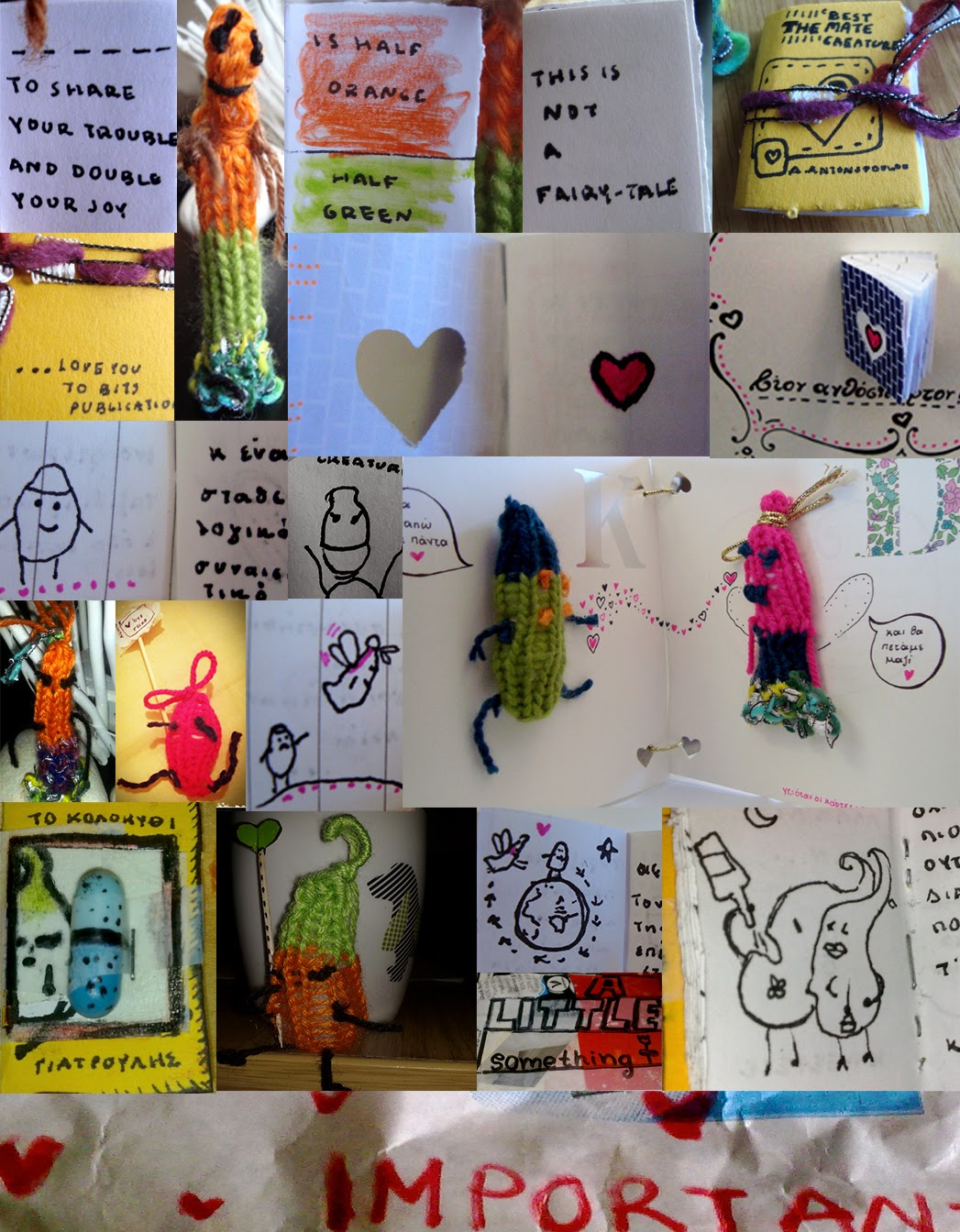
This is not a project, this is my life stories, my friends, my true love and inspiration in life...
What is this thing that I recognize, that seems to know me, when I come upon it on a street corner, in a park, or in the shadows of a theater, moving up on that small stage? What is this creature that burrows out of shadows, into the light, a remnant of something, hardheaded, often squeaking and ugly, moving with such odd, unpredictable motion, or just lying still, folded up on itself, a little warm, patiently gathering strength for some new movement? I wonder about the world in which this creature lives. I wonder more what it knows about our world.
expert from Puppet:an essay on uncanny life
I wonder what do we know about our world!
Thursday, 18 July 2013
Everyday stories
I learned to think, discover, protest and express myself better with my hands than with words. It is therefore not by chance that even now as an adult I can more easily express myself through making than through any other channel, that a feeling of euphoria and nostalgia overwhelms me when I am in a workshop space. But I also learned to imagine with my hands. I recall putting them into a container of little shiny balls that were used to polish the metals, and spend what felt like hours, feeling the metal and imagining that my fingers were the tentacles of an octopus swimming in a sea full of (metal) bubbles.
 |
| The gone fishing man |
 | ||
The curse In the memory of a black cat  Kitchen incident report- Edgecombe flat A 
Flora Academicus is an extinct species
that grows in the books' reference section.
Part of my fictional species encyclopaedia.
|

Monday, 25 October 2010


Friday, 30 October 2009
The Beauties and Beasts books
This research (2007) delves into the social aspect of fairy-tales through the changing notion of Beauty.
Part of this research resulted in the creation of two books (Antonopoulou, 2007, 2008), both of which explored philosophical discourses on reality and subjectivity. In these, I explored the connection between fairy-tale ‘fictions’ and ‘factual’ stories. The exploration ranged from fairy-tales that might have been written to propagate ideas (Zipes, 2012; Warner, 1995) to how utopian and dystopian elements within fairy tales may have influenced real life events (from scientific inventions to criminal realities). The second of these two books also traced my own personal experiences in graphic and journal form, providing a conscious reflection on how these had influenced my research choices.




Part of this research resulted in the creation of two books (Antonopoulou, 2007, 2008), both of which explored philosophical discourses on reality and subjectivity. In these, I explored the connection between fairy-tale ‘fictions’ and ‘factual’ stories. The exploration ranged from fairy-tales that might have been written to propagate ideas (Zipes, 2012; Warner, 1995) to how utopian and dystopian elements within fairy tales may have influenced real life events (from scientific inventions to criminal realities). The second of these two books also traced my own personal experiences in graphic and journal form, providing a conscious reflection on how these had influenced my research choices.
This research been presented in symposia in Goldsmiths University (2008),the Victoria and Albert Museum (2008), the Whitechapel Gallery (2009), Berlin University(2010), Copenhagen University (2009), University of the Arts London, Beijing Institute of Fashion Technology and the Beijing Institute of Graphic Design Communication in China (2010) .

Are fairytales fiction? Are “true” stories reality?
Discover the connection between fairytales and “true” stories.
Create different stories as you dive into the "Beauties and Beasts" book and live happily ever after.


moments from the showcase of the project
at the Victoria and Albert Museum, blood on paper' exhibition


2. Beauties and Beasts big wooden book : The Beauties and Beasts interactive interactive book (above) explores the connection between fact and fiction by reconstructing and remixing 'factual' newspaper stories with fictional tales on Beauties and Beasts. The book offers the opportunity to the reader to create different stories by mixing the two worlds; those of fiction and reality.


3. Beauty and Beast cookies:
Exploring how labels and perceptions might be deceiving. This illustration was created in connection with the 'beauties and beasts' book section where I explored beast's identity. In this piece I wanted to give emphasis at the beast as a poor misunderstood creature, thus sweet as a figure (inspired by King Kong first movie) and Beauty as someone that ultimately hurts the beast. However, it takes sometime to point out that the 'Beauty' eats the heart of the Beast and figure out the cruelty of the piece; it overall looks cute and sweet similarly to the often deceiving nature of Beauty.
As Angela Carter's mentions 'now as then its simple truth, sweetest tongue has sharpest tooth'
Exploring how labels and perceptions might be deceiving. This illustration was created in connection with the 'beauties and beasts' book section where I explored beast's identity. In this piece I wanted to give emphasis at the beast as a poor misunderstood creature, thus sweet as a figure (inspired by King Kong first movie) and Beauty as someone that ultimately hurts the beast. However, it takes sometime to point out that the 'Beauty' eats the heart of the Beast and figure out the cruelty of the piece; it overall looks cute and sweet similarly to the often deceiving nature of Beauty.
As Angela Carter's mentions 'now as then its simple truth, sweetest tongue has sharpest tooth'

screen-print of Angela Carter's quote
The entire project is overall a manifestation that writing- designing producing something and allowing for public view, even though it might not be intentionally done as a covered form of propaganda, has actually agency as it is soaked with our personal ideas and beliefs and values . The cookies piece was used as a self -promotion piece reflecting that my interest in the theme was not only academic but a personal identity discourse, as well as the 'Beauties and Beasts' book was making transparent how my real life emotions and incidents were intertwined with the 'fictions' of the book.
Subscribe to:
Posts (Atom)